Top 10 underrated birds of Ahmedabad
Top 10 underrated birds of Ahmedabad
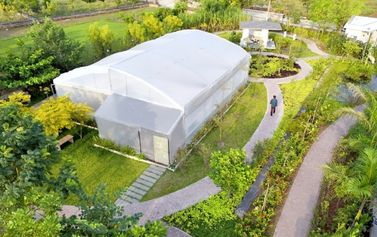
Ahmedabad is home to a variety of birds, many of which are rare or even endangered in other parts of India. It is interesting to know that the mega city hosts and houses more than 300 species of birds and nearly half of them can be spotted at Shoonya – a private, eco-luxurious farm house.
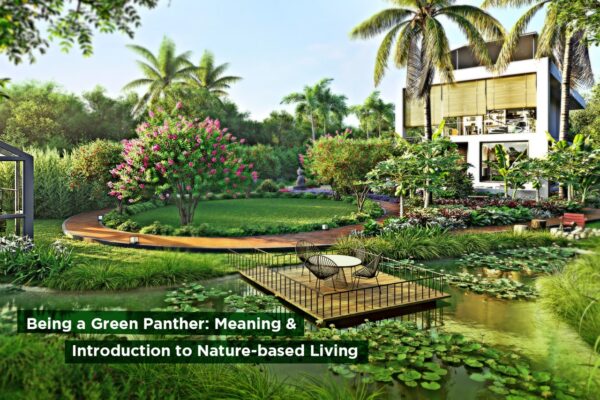
Shoonya, which is the inspiration behind Green Panther Properties developing and promoting eco-luxurious lifestyle, is the result of 5 years of research and passion to transform a barren plot of land into a nature-driven habitat that brims with biodiversity. Today, in this blog, we take you to the tour of the 10 most underrated birds of Ahmedabad that are easily found playing and singing around at Shoonya.
White-throated Kingfisher
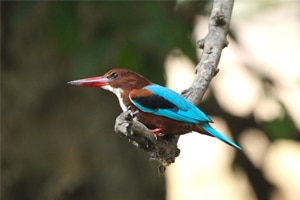
White-throated Kingfisher is a large-headed, predominantly brown kingfisher with an electric-blue back and wings, heavy orange bill and snow-white patch from the throat through the breast. It is common to spot it both near as well as away from water. This little beauty is frequently seen perched on fence posts and telephone lines near wetlands, lakes, agricultural fields and clearings. It often gives jarring, raptor-like descending trills and cackles in flight.
Purple Sunbird
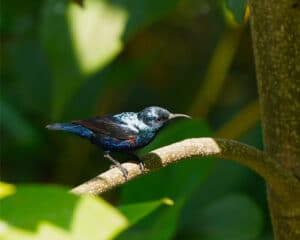
Purple Sunbird has a relatively short bill and a dark and short square-ended tail. It has a down-curved bill with brush-tipped tubular tongues that aid in nectar feeding. This metallic coloured birdie rarely hovers around flowers and usually reaches to forage for nectar. Purple sunbirds are quite noisy, with a song that is described as a rapid rattle followed by ringing, metallic notes.
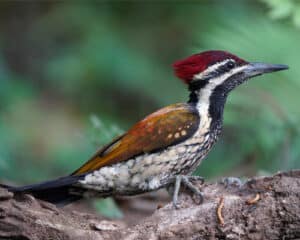
Black-rumped Flame Bird
Black-rumped Flame Bird is one of the few woodpeckers that is seen in urban areas. It is the only golden-backed woodpecker with a black throat and a black rump. It forages from the ground to the canopy. This golden fellow feeds on insects, mainly beetle larvae from under the bark, visits termite mounds and sometimes feeds on nectar. As they make hopping movements around branches, Black-rumped Flame Birds often succeed in hiding themselves from potential predators.
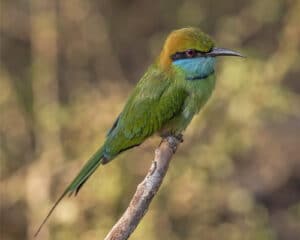
Green Bee-eater
Green Bee-eater is a tiny, exquisite bird which has bright emerald green plumage. It has a narrow black stripe known as a ‘gorget’ on its throat, and a black ‘mask’ running through its crimson eyes. Its two central, narrow, long black tail streamers are also distinctive and are only present in mature birds. As its name suggests, Green Bee-eaters eat bees. Insectivorous as they are, they also eat hymenoptera, bugs, beetles, termites, moths, flies, butterflies, crickets, dragonflies, caterpillars and spiders.
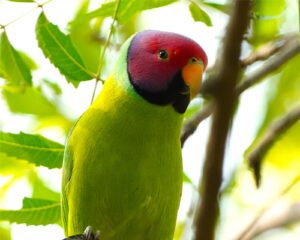
Plum-headed Parakeet
Plum-headed Parakeet is mostly native to the Indian subcontinent. It has colourful plumage and distinct vocal abilities. It is also known for having a well-defined neck ring. The Plum-headed Parakeets are moderately forest dependent. They inhabit various ecosystems including open woodland, parks, agricultural fields, subtropical and tropical forests, tropical moist lowlands and montane and submontane forests.
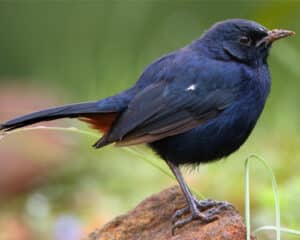
Indian Robin
The Indian Robin is found in scrub jungles and other open habitats. Males are primarily black with chestnut bottom feathers, although males in the northern population have brownish upper parts. Males also have a white shoulder patch and a relatively long tail. Females have completely brown upperparts, lack the male’s white shoulder patch, and have greyish-brown underparts. They are generally seen in pairs, foraging on the ground with the tail cocked up.
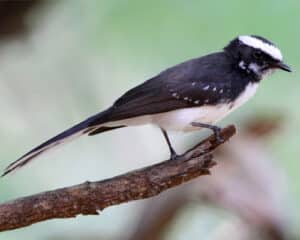
White-browed Fantail
The White-browed Fantail has blackish brown wings and upper parts. The throat has whitish patches, while the crown, eye-band and ear-coverts are black. One can find whitish spots on its wings. The diet of these White-browed Fantail species consists mainly of flying insects like flies and crickets, spiders, winged termites and ants. They feed from the lower bushes and undergrowth by gleaning insects from the foliage.
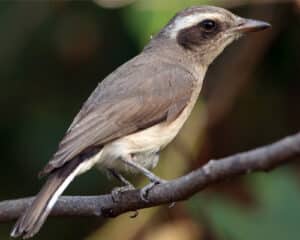
Common Woodshrike
The Common Woodshrike is dull ashy-brown in colour and like other Woodshrikes, it has a large head with a strongly hooked beak. It has a broad creamy brow above a dark cheek patch and white outer tail feathers contrasting with their dark tail. It is found across Asia mainly in thin forest and scrubs habitats. They feed mainly on insects and sometimes berries by gleaning mostly along branches and leaves within trees, but sometimes it also makes aerial sallies or descends to the ground.
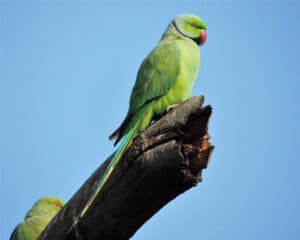
Rose-ringed Parakeet
The Rose-ringed Parakeet mostly has a green plumage. It has a long tail and a hooked beak. The upper beak is orangey-red with a black tip, while the lower bill is blackish with a paler tip. Rose-ringed Parakeets are social birds. They originally lived in semi-desert, wooded or forested areas; but have also adapted well to human-modified habitats, such as farmlands, cultivated agricultural areas and parks and gardens in villages and towns.
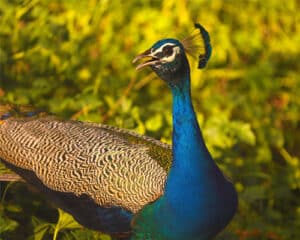
Indian Peafowl
The Indian peafowl is a magnificent member of the pheasant family native to the Indian subcontinent. This marvel of nature lives mainly on the ground where they forage in small groups. It is found in the open during the early mornings, while it likes to stay in cover during the heat of the day. Indian peafowl often dust-bathe at dusk and the groups walk in single file to a favourite waterhole to drink. Peafowl is best known for the male’s extravagant display of feathers which, despite actually growing from their back, are thought of as a tail.
Birds of Shoonya
Birds of Shoonya is a window to the splendid avian life at Shoonya Farm – a nature-driven habitat that brims with biodiversity in the outskirts of Ahmedabad. This 18 minute documentary film, featuring 35 magnificent species of birds, is the compilation of nature dweller and birder Amit Rao’s journey of 4 years of avid bird watching at his eco-luxurious farm house – Shoonya.
View brochure.
To dive deep into the world of Birds of Shoonya visit Shoonya – the inspiration behind GPP One.
To know more about us, our philosophy and our projects, visit www.greenpanther.in